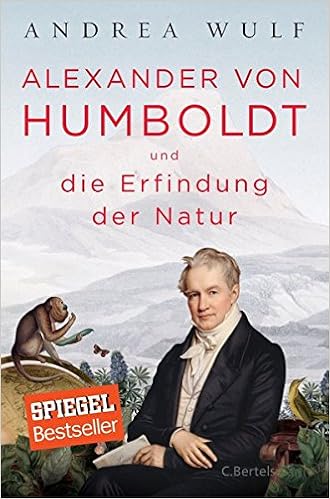
увесистый том занял у меня целый месяц
чтения, несмотря на то, что треть его занимает библиография. все же я
нисколько не жалею потраченного времени. такие книги позволяют
понимать мир более системно и глобально, видеть истоки и последствия действий
отдельных людей, их влияние на всю историю.
первым открытием в книге Андреа Вульф
для меня стало, насколько Гумбольдт, оказывается, был популярен у
современников. сейчас он почти забыт, а когда-то его имя знали лучше,
чем сегодня Майкла Джексона. но и до сих пор в мире больше всего
топонимов с именем Гумбольдта.
книга показывает ученый мир 19го века:
высочайшей вершиной считается южноамериканская Чимборасо (о которой я раньше
не слыхала); для измерения синевы неба используется приббор цианоскоп, а
город Берлин кажется Гумбольдту проклятым захолустьем (там "земля горит
под ногами").
19 век, несмотря на увеличивающуюся специализацию
науки, еще был временем универсальных ученых.
одним из близких друзей Гумбольдта
был Гёте, которого не меньше поэзии и эстетики интересовали оптика, анатомия
и геология.
сам Гумбольдт всегда стремился
объединить науку и искусство. природу нельзя познать, запершись в кабинете,
ученый должен быть в центре жизни.
нескончаемые наполеоновские войны в годы
жизни Гумбольдта сильно осложняли перемещения, но он все же много
путешествовал: по Европе, Южной и Северной Америке, России.
Гумбольдт собрал множество фактов о
природе, и создал понятие экосистемы, он писал о том, как опасна вырубка
лесов, какие разрушительные последствия имеет колониальный испанский режим
для природы Южной Америки. то же относится и к североамериканской
рабовладельческой системе, и к российскому империализму. параллели в
сегодняшнем мире очевидны: истощение природных ресурсов бедных регионов для
покрытия потребностей более богатых стран.
главная же находка книги о Гумбольдте
по-моему, в том, что Андреа Вулф не заканчивает биографию ученого его
смертью, а описывает некоторых из тех, кто "стоял на его плечах": Дарвин, Торо, Марш, Геккель и Мьюр.
|
This heavy volume took me a whole month of reading, despite the fact
that a third of it is reference. Yet I do not regret spending my time. Such
books allow us to understand the world more systematically and globally, to
see the origins and consequences of individual actions, their influence
overall history.
The first discovery in the book by Andrea Wulf for me was how popular Humboldt
was at life. Now he is almost forgotten, but once his name was known better
than today Michael Jackson is. But still, Humboldt is number one places are called for.
The book shows the scientific world of the 19th century: the highest
peak is supposed to be the South American Chimborazo (which I had never heard
of before); To measure the blue of the sky a cyanoscope is used, and the city
of Berlin seems to Humboldt a cursed backwater (where "the earth burns
under your feet").
The 19th century, despite the growing specialization of science, was
still the time of universal scientists.
One of Humboldt's close friends was Goethe, who was interested in
optics, anatomy and geology just as much as in poetry and aesthetics.
Humboldt always tried to unite science and art. The nature can not be understood,
if the scientist is locked in his office, he should be in the center of life.
The endless Napoleonic wars during the years of Humboldt's life
greatly complicated his movement, but yet he traveled a lot: across Europe,
South and North America, and Russia.
Humboldt collected many facts about nature, and created the concept of
an ecosystem, he wrote about how dangerous deforestation is, what devastating
consequences the colonial Spanish regime has for the nature of South America.
The same applies to the North American slave system, and to Russian
imperialism. Parallels in today's world are obvious: the depletion of the
natural resources of poor regions to cover the needs of richer countries.
The main finding of the book about Humboldt, in my opinion, is that Andrea
Wolfe does not finish the biography of the scientist by his death, but
describes some of those who "stood on his shoulders": Darwin, Toro,
Marsh, Haeckel and Muir.
|